anchor and anchor line
Not Without HopeThe anchor and anchor line serve as the material hinge of the 2009 Clearwater boating accident. They begin as ordinary fishing equipment, become immovable obstacles when the crew tries to leave the fishing site, and then turn a recovery maneuver into the force that pulls the boat under. After the capsizing, the line remains attached long enough to hold the overturned hull down before Will Bleakley and Marquis Cooper cut it. The object therefore connects preparation, failed decision-making, the physical mechanics of the disaster, and the survivors’ later effort to stay alive.
Appearance and Use
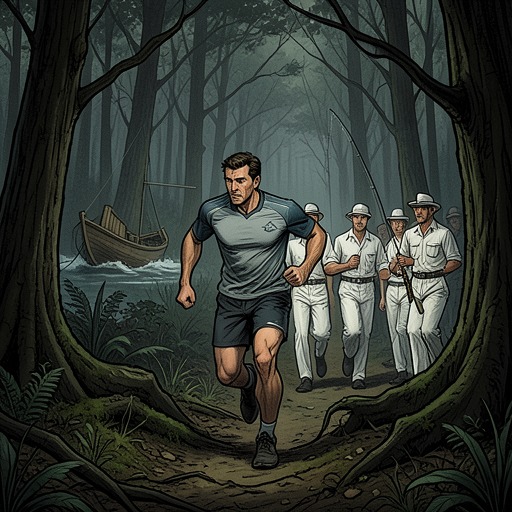
The boat’s anchor was fixed to a line that was normally handled from the bow. On the afternoon of March 1, 2009, the crew tried to retrieve it before returning toward shore, but it would not move. Marquis Cooper maneuvered the boat over the anchor while Will Bleakley pulled the line and Corey Smith helped from the bow. Even with two large, strong, fit men pulling from different positions, the anchor stayed lodged on the bottom. The narrative leaves the obstruction uncertain: it may have caught on a shipwreck, a cable, debris, or muck as much as 150 feet below the surface.
The difficulty was not entirely unprecedented. The same thing had happened on the previous fishing trip, when a friend of Marquis Cooper’s eventually cut the line; Cooper then spent two hundred dollars replacing the anchor and rope. Remembering that loss, he refused to lose another anchor. The repeated problem made the equipment familiar, but it also made the crew’s frustration more intense when the anchor again resisted retrieval.
The decision took place in deteriorating conditions. Nick Schuyler was severely seasick and unable to help, while the chop had grown into seven-foot swells. The group had not been heavily intoxicated: Corey Smith did not drink, Schuyler had consumed about a beer and a half but vomited it, Will Bleakley had seven or eight beers, and Marquis Cooper had five or six over roughly ten hours. Before leaving, Cooper had monitored a cold front and warned that the water might become rough enough to shorten the trip. By the time they tried to raise the anchor, the crew was cold, wet, sick, and eager to return, circumstances that narrowed their practical choices without removing the danger of the maneuver.
The Capsizing Mechanism
Will Bleakley proposed moving the line from the bow to the stern, tying it to a cleat, and using the engine to yank the anchor free. In his formulation, either the anchor would come loose or the line would snap; if necessary, the boat could drag whatever held the anchor until it broke free. Marquis Cooper agreed to try. He pulled the line tight and advanced the throttle while Corey Smith stood near the center console holding the canopy and Bleakley stood at the stern beside the relocated line.
The engine produced a high, motorcycle-like sound followed by a lower rumble. Bleakley cautioned Cooper not to push the throttle too hard, but the anchor did not release. Instead, its blades appear to have dug in more deeply. The stern squatted and began taking on water, the bow rose toward the sky, and the boat listed to port. The inversion happened too quickly for a Mayday call. Schuyler took one step, caught the starboard railing, and was thrown into the Gulf of Mexico as the 3,400-pound boat rolled over.
The Florida Fish and Wildlife Conservation Commission later identified three connected factors: the anchor line had been tied improperly to an eye bracket on the port side of the transom; the crew had attempted to throttle forward to pull the anchor free; and there had not been enough slack in the line. Together, those conditions allowed the stern to submerge and caused the capsizing. The official conclusion turns the line from a background detail into a clearly traceable causal link rather than treating the accident as an inexplicable effect of rough water alone.
The Line After the Inversion
The anchor line did not become irrelevant when the boat overturned. After the four men had flailed in the water for about five minutes, Will Bleakley noticed that it was still attached to the back of the boat and argued that it had to be cut. The survivors believed the line remained supertight and was holding the hull down. They maneuvered the drifting boat to gain a small amount of slack, then Bleakley and Marquis Cooper worked at the rope where it crossed the exposed propeller.
They floated at the stern and shaved the rope back and forth against the propeller as though sawing wood. The cutting took about five minutes. Once the line was severed, the back of the boat rose slightly and the group began drifting immediately. The change created a brief hope that the freed hull could now be righted, but that hope failed. Corey Smith and Schuyler lay across the stern and kicked downward while trying to pull the boat toward them; Bleakley and Cooper worked near the front and then pushed upward from the starboard side. The submerged center console acted like a large resistant rudder, and the men could not gain leverage. The boat did not come close to flipping upright, regardless of their combined strength.
The severed line thus marks a second mechanical reversal. Cutting it removed one restraint, but it did not restore the boat or its equipment. The hull remained overturned and difficult to search, while the men were left in soaked clothing, shivering as daylight diminished. By sunset, the question was no longer simply how to retrieve an anchor but how to survive beside a drifting boat that could neither be righted nor easily searched for supplies.
Safety and Search Consequences
The anchor-line decision operated within a wider set of preparedness failures. The crew had not been wearing life jackets, and the survivors did not initially know where the jackets were stored. They also lacked an emergency position-indicating radio beacon, or EPIRB, which could have transmitted the boat’s identity and location through the international search-and-rescue satellite system, either manually or automatically after an overturning. The Coast Guard later emphasized that an EPIRB might have converted a search into a rescue by providing an immediate position.
The absence of a distress signal made the anchor-line accident harder to locate and more dangerous to survive. When the Coast Guard received notice that the overdue 21-foot Everglades fishing boat had departed the Seminole Boat Ramp in Clearwater for a dive wreck about fifty nautical miles west of Clearwater Pass, communications attempts on VHF Channel 16 produced no response. In storm-darkened seas, searchers might see only a small portion of an overturned white hull among hundreds of thousands of whitecaps. The line did not cause every later difficulty, but its misuse began the chain that left the vessel capsized, silent, and difficult to find.
Retrospective Meaning
After his rescue, Nick Schuyler continued to revisit the placement of the line and the decision to use engine power. The accident investigation gave him a firm technical explanation, but not emotional closure. He wished he had been less sick and clearheaded enough to recognize that moving the line to the back of the boat was wrong. He also questioned whether better equipment, more precise information about the fishing location, flares, flashlights, or life jackets might have changed the outcome.
His retrospective questions extend beyond one person’s blame. Will Bleakley’s parents challenged the choice to put the anchor line at the back of the boat, while Schuyler explained that Bleakley had also worked to help him survive. The same line that contributed to the capsizing had to be cut before the hull could drift freely, and the same disaster exposed the consequences of missing safety layers such as an EPIRB and accessible life jackets. The anchor and anchor line therefore embody the book’s larger contrast between physical strength and maritime vulnerability: four powerful men could pull against the sea, yet a submerged anchor, a taut rope, and a badly chosen point of attachment could overturn a boat weighing more than three thousand pounds.